
Our heritage
Our Culture, Our Traditions, Our Languages Shall Survive.
The Ojibway and Cree Cultural Centre is a non-profit organization established in 1975 under the direction of Grand Council Treaty #9, now known as the Nishnawbe Aski Nation (NAN).
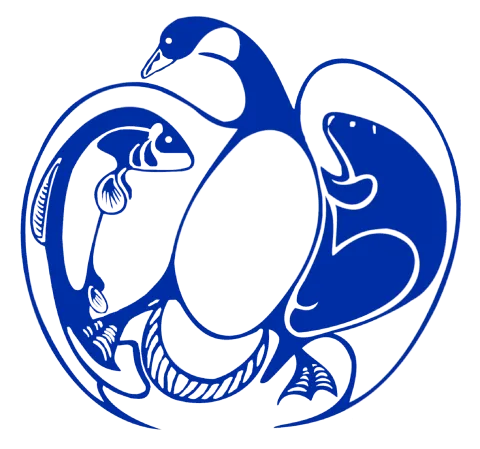
Our logo
The fish, the beaver, and the goose in our logo represent the elements needed for survival: land, water, and air.
All three are related and exist in harmony. Connected in this way, these elements remind us of the circle of life.
History
Established in 1975 under the direction of Grand Council Treaty #9.
The Centre is funded through the Cultural Education Centres program of Indian and Northern Affairs Canada (INAC) and is managed by a board of directors representing each Tribal Council area of the NAN territory.
- 1905The James Bay Treaty, Treaty No. 9, is made in 1905 and 1906, with adhesions in 1929 and 1930.
- 1975The Ojibway and Cree Cultural Centre is established as a non-profit organization, under the direction of Grand Council Treaty #9.
- TodayGrand Council Treaty #9 is now known as the Nishnawbe Aski Nation (NAN). The Centre serves 49 Native communities of the Nishnawbe Aski Nation.
Treaty No. 9
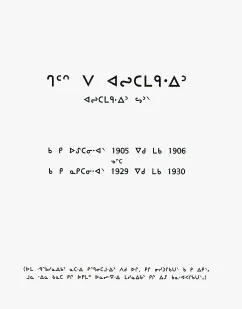
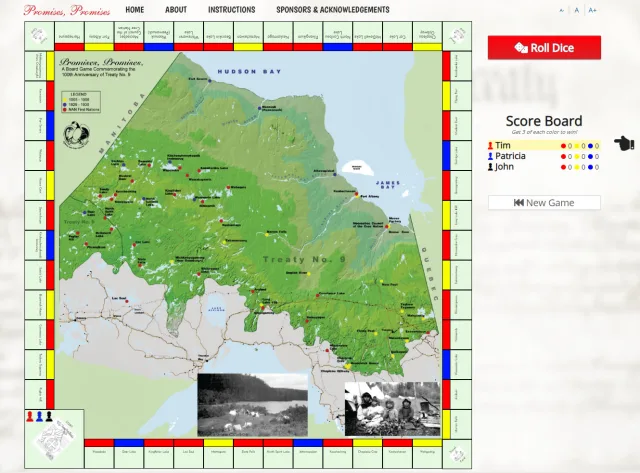
The James Bay Treaty, Treaty No. 9, was made in 1905 and 1906, with adhesions in 1929 and 1930.
The Centre was founded under the direction of Grand Council Treaty #9, and it keeps the Treaty text in its library in Cree and English.
Vision and mandate
In the Centre’s own words.
Our vision
To fulfil its role within the Nishnawbe Aski Nation (NAN), the Ojibway and Cree Cultural Centre seeks to:
- Maintain and strengthen the cultural identity of Aboriginal people in the NAN territory.
- Develop positive images for Aboriginal people in the NAN communities.
- Make society aware of the importance of Aboriginal culture, and develop a better understanding and appreciation of NAN heritage.
Our mandate
- To encourage and support NAN communities in their efforts toward self-determination.
- To promote and encourage the establishment of library and information services in Nishnawbe Aski Nation communities.
- To develop culturally relevant educational and language materials for Nishnawbe Aski Nation schools.
- To work with Aboriginal communities and schools on educational and cultural matters.
- To support and maintain the use of the Aboriginal languages of the Nishnawbe Aski Nation.
- To promote and assist in cultural events and activities that will help instil and maintain the customs, knowledge, skills, values and arts of the NAN people.
- To work in close harmony with other organizations whose aims and objectives are similar to those of the Ojibway and Cree Cultural Centre.
- To involve our elders and youth in meeting the objectives of the Ojibway and Cree Cultural Centre.
Services
Language, education and the Resource Centre.
- LanguageTranslation of documents and interpreting in courts, social agencies and meetings, with learning materials in Cree, Oji-Cree and Ojibway.Language services
- EducationProgram, curriculum and professional development support for NAN schools, and cross-cultural workshops.Education support
- Resource CentreA lending library of approximately 6,500 titles, and the Centre’s own catalogue online.Search the library
The Nishnawbe Aski Nation
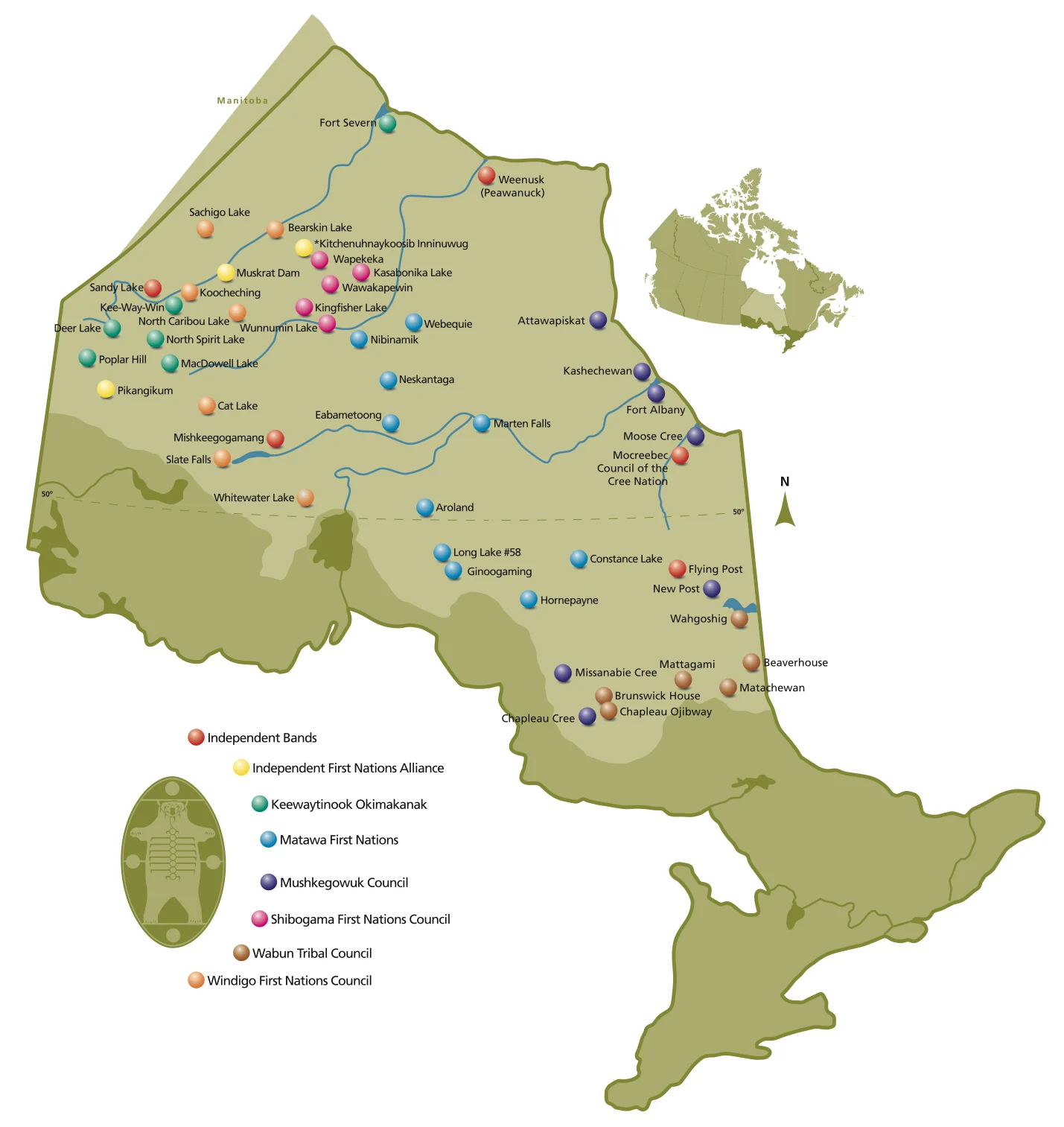
The Centre serves the communities of the Nishnawbe Aski Nation, across northern Ontario north of the 50th parallel. Most are reachable by air only.
Our catchment area
- Communities
- The Ojibway and Cree Cultural Centre serves 49 Native communities of the Nishnawbe Aski Nation (formerly known as Grand Council Treaty #9).
- Access
- Ninety percent of these communities are accessible by air only.
- Area
- The area covers 210,000 square miles and comprises the whole of Northern Ontario north of the 50th parallel.
- Population
- This area has a native population of approximately 45,000 people.
Tribal Councils and their communities
-

Independent First Nations Alliance
Muskrat Dam, Pikangikum, Lac Seul
Visit website (opens in a new tab) -
Independent
Flying Post, Mishkeegogamang, Mocreebec Council of the Cree Nation, Sandy Lake, Weenusk
-
Keewaytinook Okimakanak
MacDowell Lake, Poplar Hill, Deer Lake, North Spirit Lake, Keewaywin, Fort Severn
Visit website (opens in a new tab) -
Matawa First Nations
Hornepayne, Constance Lake, Ginoogaming, Long Lake #58, Aroland, Marten Falls, Eabametoong, Neskantaga, Webequie, Nibinamik
Visit website (opens in a new tab) -
Mushkegowuk Council
Moose Cree, Fort Albany, Kashechewan, Attawapiskat, Chapleau Cree, Taykwa Tagamou, Missanabie Cree
Visit website (opens in a new tab) -
Shibogama First Nation Council
Wunnumin Lake, Wapekeka, Wawakapewin, Kingfisher, Kasabonika
Visit website (opens in a new tab) -
Wabun Tribal Council
Wahgoshig, Beaverhouse, Matachewan, Mattagami, Chapleau Ojibwe, Brunswick House
Visit website (opens in a new tab) -

Windigo First Nations Council
Bearskin Lake, Sachigo Lake, Cat Lake, Koocheching, North Caribou Lake, Slate Falls, Whitewater Lake
Visit website (opens in a new tab)
Board and staff
The Centre is managed by a board of directors representing each Tribal Council area of the NAN territory.
Board of directors
- Irene RossPresidentIndependent First Nation Alliance
- Cathy TherriaultVice-PresidentMatawa First Nations Council
- Gary NaveauSecretary/TreasurerWabun Tribal Council
- Deputy Grand Chief Derek FoxEx-Officio MemberNishnawbe Aski Nation
- Geordie KakepetumMemberKeewaytinook Okimakanak
- Bill LoutittMemberMushkegowuk Council
- RepresentativeMemberShibogama First Nations Council
- Frank McKayMemberWindigo First Nations Council
Staff
Staff names and contact details are listed on the Contact page.
Visit or contact us
Address: 150 Brousseau Avenue, Unit B
Timmins, ON P4N 5Y4
- Phone
- (705) 267-7911
- Fax
- (705) 267-4988
- info@occc.ca
Contact the Centre Get directions (opens a map in a new tab)